



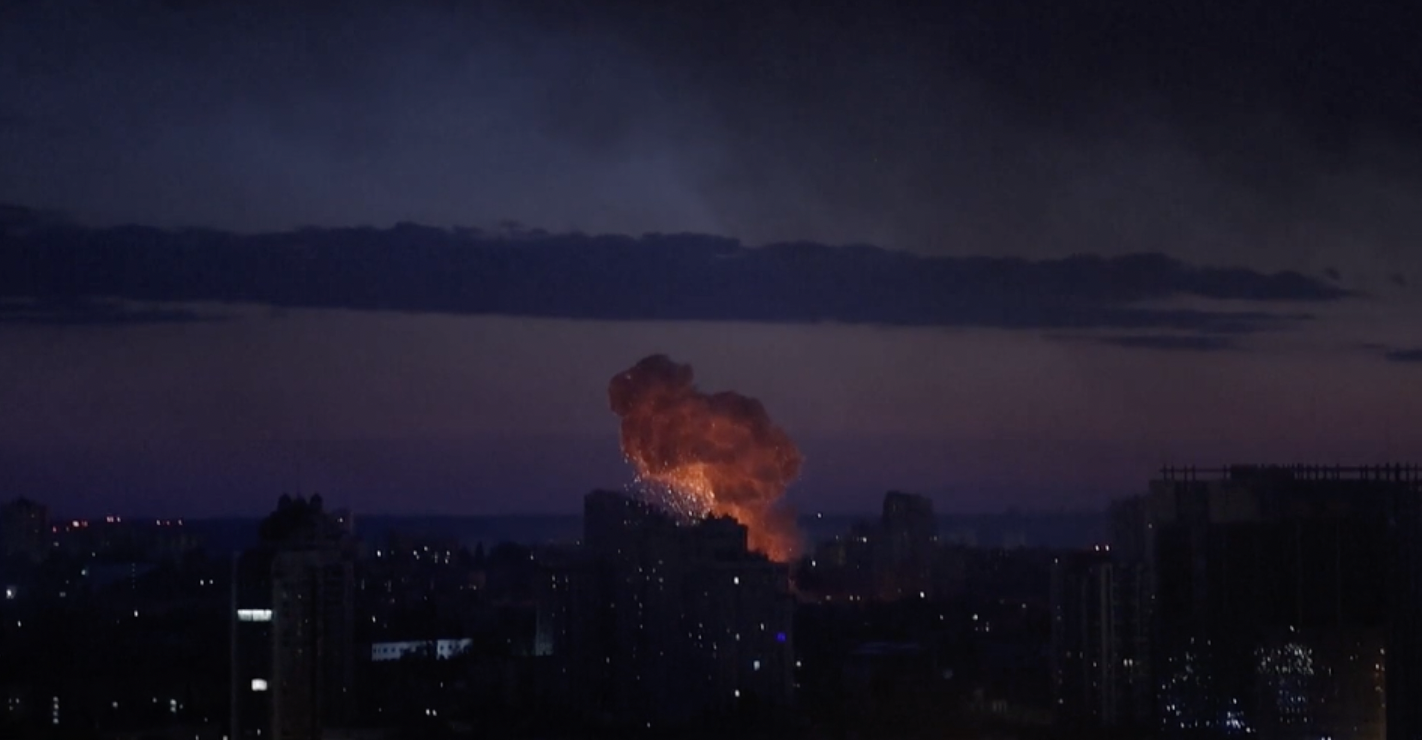

A devastating, high-intensity wave of overnight aerial assaults executed by Russian forces has left at least four individuals dead and dozens more wounded across Ukraine. According to official statements from Ukrainian authorities, the midnight offensive involved hundreds of loitering munitions and dozens of sophisticated cruise and ballistic missiles, targeting critical hubs across the nation.
Ukrainian President Volodymyr Zelensky confirmed that while the primary focus of the Kremlin’s barrage was the capital city of Kyiv, multiple municipal sectors throughout the country sustained severe damage. The latest casualty figures indicate that nearly 100 civilians have suffered varying degrees of injuries. The overnight operations triggered relentless explosions that echoed through residential quarters, completely shattering windows and tearing through structural foundations.
Hypersonic Weapons and Infrastructural Toll
The Russian Ministry of Defense openly acknowledged the deployment of its cutting-edge Oreshnik hypersonic missile during the campaign. Moscow justified the escalation as a direct retaliatory countermeasure against what it labeled Ukrainian “attacks on civilian infrastructure.” This explanation follows allegations from Russian President Vladimir Putin concerning an earlier strike on a student housing facility in Russian-occupied Starobilsk. However, the Ukrainian military has repeatedly denied deliberately targeting non-combatants, maintaining that its overnight operations strictly focused on a high-value, elite Russian drone military detachment operating in the occupied eastern sector.
The material destruction inside Kyiv is extensive. Local emergency services report that dozens of multi-story residential blocks, an educational institution, a historic opera house, and the renowned Chornobyl Museum were either severely compromised or entirely ruined. Commenting on the cultural losses, Ukraine’s Interior Minister Ihor Klymenko characterized the destruction of the museum as a highly calculated attempt to erase historical truths and national memory.
Air Defense Interceptions and Direct Hits
Data released by the Ukrainian Air Force underscores the unprecedented scale of the bombardment. Radar systems tracked an estimated 90 missiles and roughly 600 drones entering sovereign airspace. Preliminary operational metrics reveal that Ukrainian air defense teams successfully intercepted and neutralized 55 ballistic and cruise missiles alongside 549 drones. Despite these high interception rates, military officials acknowledged at least 16 direct missile impacts and 51 drone detonations distributed across 54 distinct coordinates, striking civilian shopping centers, public utilities, and water-supply networks.
“The capital alone saw at least 69 civilian injuries during this single wave, demonstrating the deliberate density of the strike packages deployed against urban centers,” noted President Zelensky during an afternoon inspection of the ruins.
Global Condemnation and Geopolitical Fallout
The lethal escalation has drawn fierce criticism from Western allies. European Union foreign policy chief Kaja Kallas sharply criticized the operational deployment of the high-velocity Oreshnik system, describing the maneuver as a form of reckless nuclear brinkmanship and a calculated political scare tactic designed to undermine Western resolve. This sentiment was echoed across European capitals, with French President Emmanuel Macron and German Chancellor Friedrich Merz issuing strong statements condemning the Kremlin’s reliance on high-speed ballistic systems that travel at multiple times the speed of sound and present significant interception challenges.
Concurrently, British Foreign Secretary Yvette Cooper expressed deep sorrow over the harrowing developments emerging from Kyiv. She pledged that the United Kingdom would continuously intensify economic and diplomatic pressure on Moscow to halt its ongoing aggression, which began with the full-scale invasion launched in February 2022.
Human Toll Shared Beyond the Border
The profound psychological and emotional impact of the ongoing conflict resonated deeply within the international sports arena. At the French Open in Paris, prominent Ukrainian tennis professional Marta Kostyuk was visibly overcome with emotion following her first-round victory, stating that her thoughts remained entirely with her compatriots enduring the bombardment.
Similarly, heavyweight boxing champion Oleksandr Usyk, who successfully defended his world titles against challenger Rico Verhoeven in Egypt, dedicated his performance to those forced into bomb shelters. Usyk revealed to reporters that his own daughter had sent him a supportive text message from an underground bunker moments before his bout, a stark reminder of the volatile reality currently facing millions of Ukrainian citizens.