



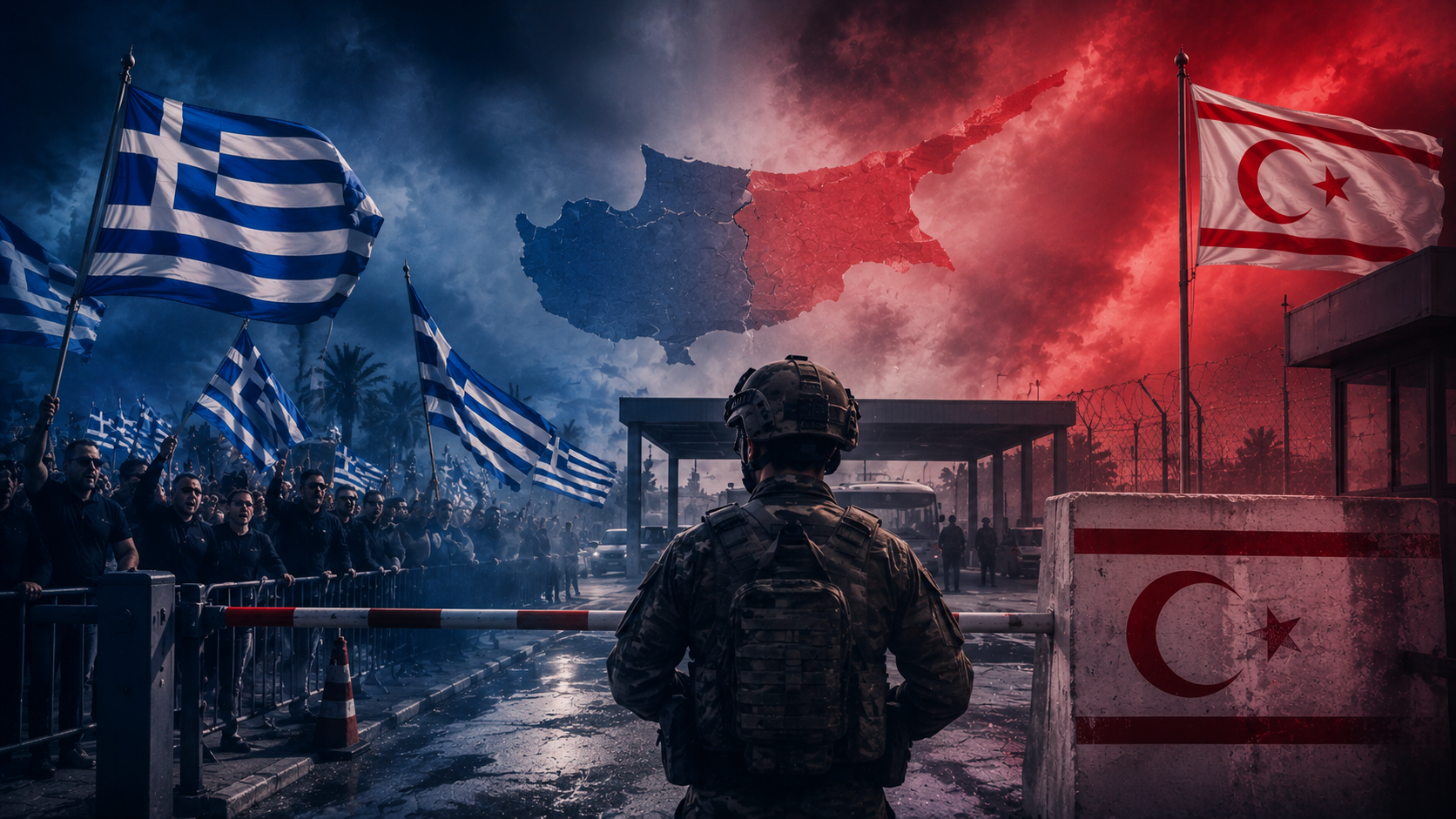

A demonstration organized by a group of Greek Cypriot activists near the Metehan Border Crossing has renewed political tensions on the divided island of Cyprus just days before North Cyprus marks the anniversary of the July 20 Peace Operation. Although the protest remained contained, the slogans displayed by demonstrators prompted criticism from officials and observers concerned about the impact of nationalist rhetoric on intercommunal relations.
Security forces on both sides of the buffer zone maintained a visible presence throughout the demonstration, preventing the situation from escalating into physical confrontation.
Protest Held Near Border Crossing
Nationalist Slogans Draw Attention
The demonstration took place on the South Cyprus side of the Metehan Border Crossing, where participants gathered carrying Greek flags and banners directed against Turkey and the Turkish Cypriot community.
According to local reports, protesters displayed signs reading “Turks Out of Cyprus” and “No to Federation,” while chanting anti-Turkish slogans during the gathering.
Authorities from both North Cyprus and South Cyprus implemented heightened security measures along the crossing, ensuring that the demonstration remained confined to its designated area.
Organizers later announced plans for another event on July 20 at the Ledra Palace Border Crossing, describing it as a “Grand Gathering” to coincide with commemorations taking place in North Cyprus.
Anniversary Comes Amid Longstanding Political Division
The protest coincides with preparations for the 52nd anniversary of the July 20 Peace Operation, one of the most politically significant dates in North Cyprus.
The operation, launched by Turkey in 1974, followed a coup on the island backed by the Greek military junta and remains one of the defining events in modern Cypriot history. Today, the island continues to be divided between North Cyprus and South Cyprus, with negotiations under United Nations auspices continuing intermittently for decades without a comprehensive settlement.
Public commemorations held each July often coincide with demonstrations, political statements, and renewed debate over the island’s future.
Nationalist Groups Continue to Influence Public Debate
The latest protest has also revived discussion about the role of nationalist organizations in shaping public discourse on Cyprus.
Earlier this year, reports involving activities linked to EOKA-affiliated extremist sympathizers once again drew attention to the persistence of radical nationalist narratives among a small number of political groups. While such organizations receive significant media attention, political analysts note that they represent only a limited segment of society rather than the broader population.
Security officials on both sides of the island continue to monitor demonstrations closely to prevent isolated incidents from escalating into wider tensions.
Extremism Does Not Reflect Most Greeks or Turks
Although provocative demonstrations periodically generate headlines, many analysts argue that they do not represent the views of the overwhelming majority of Greek and Turkish citizens.
For decades, millions of Greeks and Turks have traveled, traded, studied, and lived peacefully alongside one another both in Greece and Türkiye. Cultural similarities—including strong family traditions, hospitality, Mediterranean cuisine, music, and shared Balkan heritage—have long been recognized as important foundations for dialogue between the two societies.
Political scientists frequently note that nationalist rhetoric tends to become more visible during periods of domestic political competition, when fringe organizations or hardline political figures seek public attention through emotionally charged messages. While these actions often receive disproportionate media coverage, opinion surveys and people-to-people exchanges have consistently shown growing support for peaceful coexistence, regional cooperation, and improved bilateral relations.
The latest demonstration near the border illustrates how relatively small activist groups can temporarily inflame tensions, particularly around historically significant anniversaries. However, diplomatic observers emphasize that isolated protests should not be interpreted as reflecting the broader relationship between the Greek and Turkish peoples.
As Cyprus continues to search for a lasting political settlement, analysts argue that reducing inflammatory rhetoric and encouraging dialogue between communities remains essential. Many believe that long-term stability will depend less on nationalist symbolism and more on practical cooperation, confidence-building measures, and sustained diplomatic engagement supported by both communities and the wider international community.
Sources: Local authorities in North Cyprus and South Cyprus, statements from protest organizers, publicly available reports on events at the Metehan and Ledra Palace border crossings, and background information from the United Nations Peacekeeping Force in Cyprus (UNFICYP).