



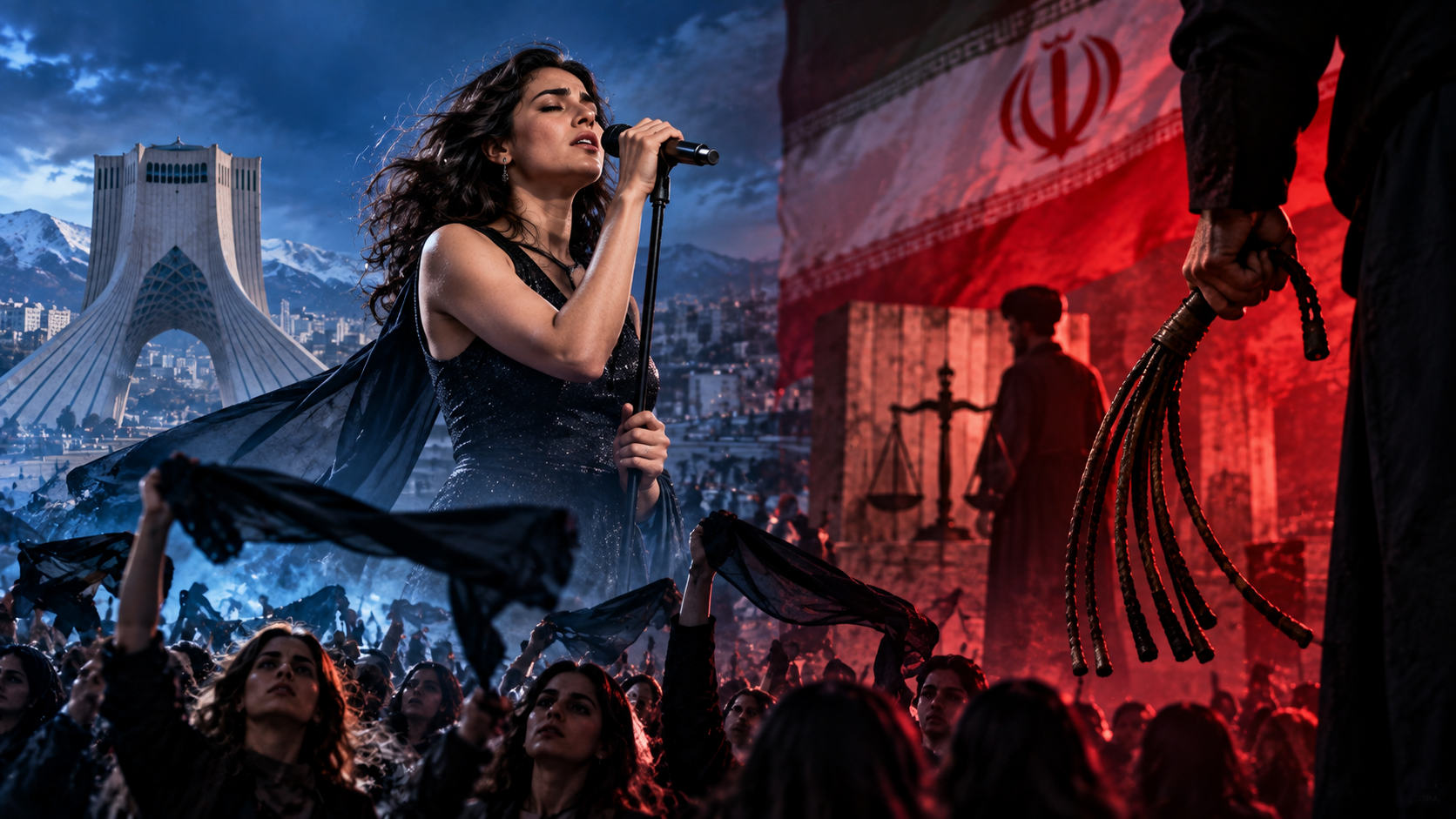

An Iranian appeals court has upheld a sentence of 74 lashes against singer Parastoo Ahmadi, whose livestreamed performance without the country’s mandatory hijab became a viral symbol of women’s continuing challenge to restrictions on dress and artistic expression.
Ahmadi’s lawyers said the appeal was rejected without a hearing, leaving intact one of the harshest elements of the sentence imposed over her December 2024 performance. The case has drawn renewed attention to Iran’s use of corporal punishment and restrictions on female performers.
The 29-year-old singer performed in a sleeveless dress without a headscarf during what became known as the Caravanserai Concert, which was streamed online without an audience.
The performance spread rapidly across social media and attracted millions of views, transforming what began as a musical event into a highly visible challenge to Iran’s rules governing women’s clothing and public performance.
74 Lashes Over Livestreamed Concert
A criminal court in Qom Province convicted Ahmadi and eight musicians and production personnel in June 2026.
According to the published verdict, the defendants were found guilty of an offense concerning public decency through the production and distribution of content authorities characterized as obscene or immoral.
The court cited provisions of Iran’s Islamic Penal Code and Computer Crimes Law and sentenced the defendants to 74 discretionary lashes, along with two-year bans on artistic activities and leaving the country.
Ahmadi’s attorneys challenged the judgment.
According to reporting on the appeal, her lawyers argued that staging the concert should not have constituted a crime and criticized the lower court for choosing an exceptionally severe punishment when other penalties were available.
The appeals court nevertheless rejected the challenge without holding a hearing, according to her legal team.
Women Face Extensive Restrictions on Performance
Ahmadi’s case extends beyond the question of whether she wore a headscarf.
Women in Iran face extensive restrictions on solo public singing, while compulsory veiling rules have regulated women’s appearance in public since the establishment of the Islamic Republic.
The December 2024 concert therefore challenged multiple restrictions simultaneously: Ahmadi appeared without the mandatory head covering and performed as a female solo singer.
Iranian authorities opened a criminal case following the video’s publication. The venue connected with the performance was also sealed, according to human rights reporting on the case.
Flogging Remains a Human Rights Issue
The punishment has generated criticism partly because flogging continues to be used by Iranian courts for offenses ranging from political and social dissent to violations of morality laws.
Human rights organizations have repeatedly condemned the practice.
Amnesty International considers flogging a form of cruel, inhuman or degrading punishment and has documented its use against Iranians prosecuted for defying compulsory veiling and other restrictions.
Ahmadi would not be the first Iranian punished this way in connection with opposition to compulsory hijab rules.
In January 2024, Iranian authorities carried out a 74-lash sentence against Roya Heshmati after she appeared unveiled in public. Heshmati later described being flogged by a male official in the presence of a judge.
The punishment has also been used against musicians.
In March 2025, singer Mehdi Yarrahi received 74 lashes in connection with his protest song opposing Iran’s compulsory veiling rules, according to Amnesty International.
Mahsa Amini Changed the Hijab Debate
The confrontation between Iranian women and the state over compulsory hijab entered a dramatically different phase following the September 2022 death of Mahsa — also known by her Kurdish name Jina — Amini.
The 22-year-old Kurdish Iranian woman was detained in Tehran by Iran’s morality police over what authorities considered an improper hijab. She collapsed after her detention and died three days later.
The United Nations documented allegations that Amini was subjected to physical violence in custody, while Iranian authorities maintained that she died from natural causes. The UN called for an independent investigation into her death.
Her death triggered the Woman, Life, Freedom movement, with demonstrations spreading across Iran.
Women publicly removed and burned headscarves, while many began appearing without compulsory veiling in streets, businesses and other public spaces.
The protests developed into a much broader challenge to the Iranian political system, and authorities responded with mass arrests and deadly force.
Iran Continues Pressure Over Compulsory Hijab
The disappearance of headscarves from many streets after 2022 did not mean Iran had abolished compulsory veiling.
Authorities instead developed additional enforcement methods, including surveillance technology, vehicle confiscations, prosecutions, business closures and other penalties, according to Amnesty International.
A more restrictive compulsory-veiling law adopted in 2024 proposed even more severe penalties for women and girls who resisted the rules, although Iranian state media subsequently reported that its formal implementation had been temporarily paused.
The confrontation has increasingly reached Iran’s cultural sector as well.
Artists, musicians, actors and other public figures occupy an unusually visible position because performances can spread far beyond the physical venue through social media. Ahmadi’s concert demonstrated that effect dramatically: a performance staged without a conventional audience became a national and international political controversy after being broadcast online.
A Concert Becomes a Symbol
Ahmadi’s case illustrates how disputes over music, women’s clothing and artistic freedom have become intertwined with Iran’s broader political struggle over personal freedoms.
To Iranian authorities, the case was prosecuted under laws governing public morality and online content.
To Ahmadi’s attorneys and human rights advocates, it represents something very different: the criminalization of artistic expression and women’s personal choices.
That disagreement now carries a physical punishment.
With the appeals court rejecting the challenge to her conviction, 74 lashes remain part of the sentence against Parastoo Ahmadi, more than a year after a headscarf-free concert broadcast from an empty venue transformed the young Iranian singer into another prominent figure in the continuing confrontation over compulsory veiling.
The case also demonstrates that nearly four years after Mahsa Amini’s death, the conflict that fueled the Woman, Life, Freedom protests remains unresolved. Iranian women continue challenging restrictions in everyday life and cultural spaces, while the state continues using criminal law — including flogging, travel restrictions and professional bans — to enforce the boundaries it has imposed.