



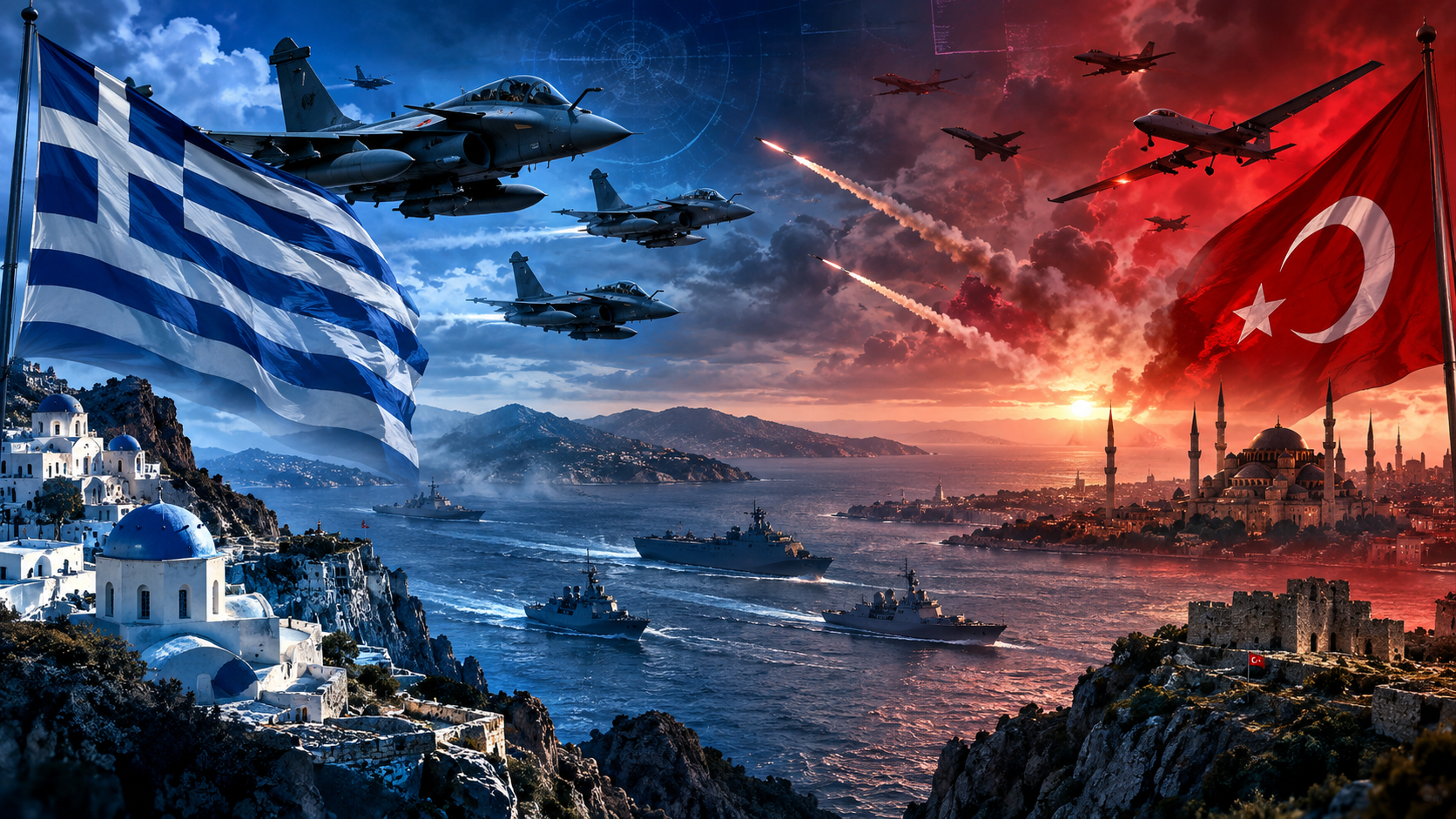

A scenario published in the Greek press has brought renewed attention to a particularly sensitive aspect of Greek-Turkish military relations: the possibility of Greece striking first rather than waiting for Turkish forces to open fire.
The distinction is important. The scenario should not simply be described as a Greek response after a Turkish attack. It examines a preemptive strike, meaning Greek decision-makers would act on intelligence indicating that they believed a threat had become imminent and potentially irreversible.
That would leave Athens facing an extraordinarily consequential decision: launch military action before Turkey had carried out the attack Greece believed was coming, or wait and risk losing the operational initiative.
The scenario is not evidence that the Greek government has formally decided to attack Turkey, nor should a media analysis be presented as an authenticated secret war plan. But the concept of preemption itself is not merely a newspaper invention. General Dimitrios Houpis, chief of Greece’s National Defense General Staff, publicly discussed Greece’s ability to deliver long-range strikes with strategic effect, including a preemptive dimension, in late 2025.
The First 24 Hours
Under the scenario described in the Greek press, the confrontation would begin with intelligence rather than gunfire.
Greece’s National Intelligence Service (EYP) would reportedly evaluate Turkish military movements with information that could include satellite intelligence supplied by allied countries. The Government Council for National Security (KYSEA) would then be called upon to decide whether the perceived threat justified action.
The fundamental risk is obvious.
If Greece acted first and its intelligence assessment proved incorrect, exaggerated or incomplete, Athens could find itself trying to convince NATO allies and the wider international community that its first strike constituted legitimate anticipatory self-defense rather than aggression.
That distinction would become critical because the scenario subsequently depends heavily on diplomatic intervention by Greece’s allies.
Greek Aircraft Would Hit Targets Inside Turkey
The next stage is significantly more direct.
The scenario envisions Greek electronic-warfare capabilities attempting to disrupt Turkish radar, communications and drone infrastructure, creating an opening for conventional strikes.
Greek Rafale and F-16 Viper fighter aircraft could then be used against selected military infrastructure inside Turkey. The scenario identifies airfield infrastructure, including runways at Dalaman, Balikesir and Cigli, while Spike NLOS and Exocet systems could be directed against Turkish amphibious forces before they deployed from their bases.
In other words, the scenario is not simply about defending Greek airspace after Turkish bombs begin falling. It considers circumstances in which Greek forces would attempt to hit Turkish military targets first because Athens had concluded that an attack was imminent.
Turkey’s anticipated response is described as involving missiles and unmanned aerial vehicles. Greece would then employ systems including Patriot air defenses and the advanced SeaFire radars installed on its new Kimon-class frigates.
Then Comes NATO
Perhaps the most politically striking element comes after the shooting starts.
The scenario anticipates intense diplomatic intervention during or after the first 24 hours, with the United States, NATO and European Union pushing the two countries toward a ceasefire. France could also become particularly important because of its bilateral defense relationship with Greece.
The underlying theory is that Greece could enter subsequent negotiations having already created a favorable military situation.
But that assumption raises an uncomfortable question: What happens if the NATO member seeking allied diplomatic or defensive support was also the country that fired first?
The answer would depend heavily on the circumstances, the intelligence available before the strike and the applicable rules of international law. NATO’s collective-defense system does not turn every military action undertaken by an ally into an automatic alliance war.
It is therefore important to separate a Greek media scenario from an established NATO response. The alliance’s reaction to any real Greek-Turkish confrontation would depend on the facts of that confrontation.
The Aegean Dispute Has a Longer History
The latest scenario also cannot be understood in isolation from decades of disputes in which Athens and Ankara have offered sharply conflicting interpretations of international law.
One major disagreement concerns territorial waters in the Aegean.
Greece maintains that international law, including the principles codified in the United Nations Convention on the Law of the Sea (UNCLOS), gives it the sovereign right to extend its territorial sea from six to 12 nautical miles. Greece has already exercised that right in the Ionian Sea.
Turkey, which is not a party to UNCLOS, disputes the implications of such an extension in the geographically distinctive Aegean and argues that unresolved maritime areas must be settled equitably. Ankara says the continental shelf beyond the countries’ existing six-nautical-mile territorial seas remains undelimited.
The disagreement became considerably more serious in 1995, when the Turkish Grand National Assembly authorized the Turkish government to take measures it considered necessary, including military measures, if Greece extended its territorial waters beyond six nautical miles in the Aegean. Greece describes that resolution as a continuing casus belli threat.
The episode therefore does not support a simple narrative in which either government has relied exclusively on diplomacy. What it demonstrates is a long-running dispute in which legal arguments, diplomatic negotiations, deterrence and military signaling have repeatedly existed side by side.
The Dispute Over Militarized Islands
Another issue frequently missing from discussions of Greek-Turkish tensions concerns the military status of islands close to the Turkish coast.
Turkey argues that several Eastern Aegean islands and the Dodecanese are subject to demilitarization or military restrictions under international agreements, particularly the 1923 Treaty of Lausanne and 1947 Paris Peace Treaty.
Article 13 of Lausanne imposed military restrictions concerning Lesvos, Chios, Samos and Ikaria, while the 1947 Paris settlement placed the Dodecanese under a demilitarized status when Italy transferred sovereignty to Greece.
Ankara has repeatedly accused Greece of violating those obligations by deploying military forces and equipment to islands covered by the treaties.
Athens rejects Turkey’s broader legal interpretation. Greece argues that the treaty regimes governing different groups of islands are not identical, points to subsequent legal developments including the 1936 Montreux Convention, and invokes its right of self-defense under Article 51 of the UN Charter. Greece also cites Turkish military deployments on the Anatolian coast and Turkey’s 1995 parliamentary resolution.
The disagreement is therefore real, but so is the underlying historical fact: the military status of islands close to Turkey was expressly regulated by international treaties, and Ankara has repeatedly sought their demilitarization through diplomatic and legal arguments. Greece, meanwhile, maintains that its current defensive posture is lawful.
That context matters when Greek political discourse portrays Turkey exclusively as the state generating military pressure in the Aegean.
Cyprus Cannot Be Removed From the History
The same applies to Cyprus, where simplified modern narratives often omit the violence that preceded and accompanied the island’s division.
Intercommunal violence had already become severe by 1963-64, prompting the deployment of the United Nations Peacekeeping Force in Cyprus (UNFICYP) in 1964.
A decade later, the Greek military junta backed the July 15, 1974 coup against Cypriot President Makarios, seeking a political transformation of the island. EOKA-B, the Greek Cypriot ultranationalist paramilitary organization, participated in the coup environment.
Turkish Cypriot civilians were also victims of serious atrocities during the conflict. Killings at Maratha, Santalaris, Aloda and Tochni became some of the darkest episodes of 1974.
Turkey intervened militarily on July 20 under its interpretation of the 1960 Treaty of Guarantee. Greece and the Greek Cypriot side characterize Turkey’s subsequent military actions and continuing presence in northern Cyprus as an invasion and occupation, while Turkey describes its initial intervention as an exercise of guarantor rights and emphasizes the preceding coup and violence against Turkish Cypriots.
Those competing legal and historical narratives remain fundamental to the Cyprus dispute today.
What should not disappear from the historical record is that Turkish Cypriot civilians suffered organized violence and killings, just as the later conflict displaced and inflicted severe suffering on Greek Cypriot civilians.
Turkey’s Role in Greece’s NATO Return
There is another largely forgotten chapter in the relationship.
Greece and Turkey originally joined NATO together in 1952. Greece did not need Turkish permission for an initial membership that Turkey already possessed; both entered the alliance simultaneously.
The situation changed dramatically after Cyprus.
Greece withdrew from NATO’s integrated military command structure in 1974, although it remained a member of the alliance. When Athens later sought reintegration, disagreement with Ankara over command arrangements in the Aegean became a major obstacle.
Contemporary records show that Turkey was in a position to block Greece’s return.
After negotiations led by NATO Supreme Allied Commander Europe General Bernard Rogers, Ankara ultimately accepted the arrangements. Greece returned to NATO’s integrated military structure in October 1980.
Contemporary reporting described Rogers as having persuaded Turkey to lift its opposition, while historical U.S. documents confirm that Turkish objections had been a central issue during the reintegration negotiations.
It is therefore historically fair to say that Greece’s 1980 return to NATO’s military command required an accommodation with Turkey and became possible after Ankara ceased blocking the process.
Political Conflict, Social Similarity
All of this makes the relationship between the two populations particularly striking.
Greeks and Turks are among the world’s most culturally similar neighboring societies, with centuries of intertwined history visible in cuisine, music, family traditions, language, architecture and everyday customs. Political borders have never completely erased those connections.
Public-opinion research also shows something that military scenarios can easily obscure.
A joint research program involving ELIAMEP and the Istanbul Policy Center found substantial support for peaceful coexistence on both sides. In one survey, 60% of Greeks and 74% of Turks said they could have someone from the neighboring country as a friend. Another 68% of Greeks and 73% of Turks agreed that the two peoples are neighbors who must find a way to live together amicably.
The societies are not identical, nor do Greeks and Turks necessarily agree about Cyprus, the Aegean or their countries’ respective historical responsibilities. Yet the polling indicates that hostility between governments should not automatically be interpreted as hostility between populations.
That creates one of the enduring contradictions of the Greek-Turkish relationship.
Nationalist and right-wing political currents have periodically used security disputes and historical grievances to portray the country across the Aegean as a threat. At the same time, ordinary Greeks and Turks continue to travel, trade, form friendships, share cultural traditions and demonstrate substantial support for peaceful coexistence.
History Is More Complicated Than a Single Aggressor Narrative
None of this establishes that Turkey has been blameless throughout the history of Greek-Turkish disputes. Nor does it establish that every Greek security concern is manufactured.
It does show why the historical record cannot be reduced to a story in which Greece merely reacts while Turkey always initiates.
Athens and Ankara have both taken decisions that the other regards as threatening. They continue to disagree over territorial waters, maritime jurisdiction, airspace, the military status of Aegean islands and Cyprus. Their governments also disagree over the legal meaning of several of the treaties invoked in those disputes.
Against that background, the newly publicized 24-hour preemptive-strike scenario deserves scrutiny precisely because it reverses a familiar rhetorical sequence.
Under the scenario, Greece would not necessarily wait for Turkey to attack first. Greek forces could strike targets on Turkish territory after Athens concluded, on the basis of intelligence, that a Turkish attack was imminent.
Whether such a decision could legally qualify as anticipatory self-defense would depend on facts that cannot be established in advance. A mistaken assessment could instead produce the very war the operation was intended to prevent.
And beneath those military calculations remains the central paradox of the Aegean: two neighboring societies with extraordinary cultural proximity and demonstrated public support for peaceful coexistence continue to watch political and military establishments prepare for a conflict that most people on either shore may never want.