



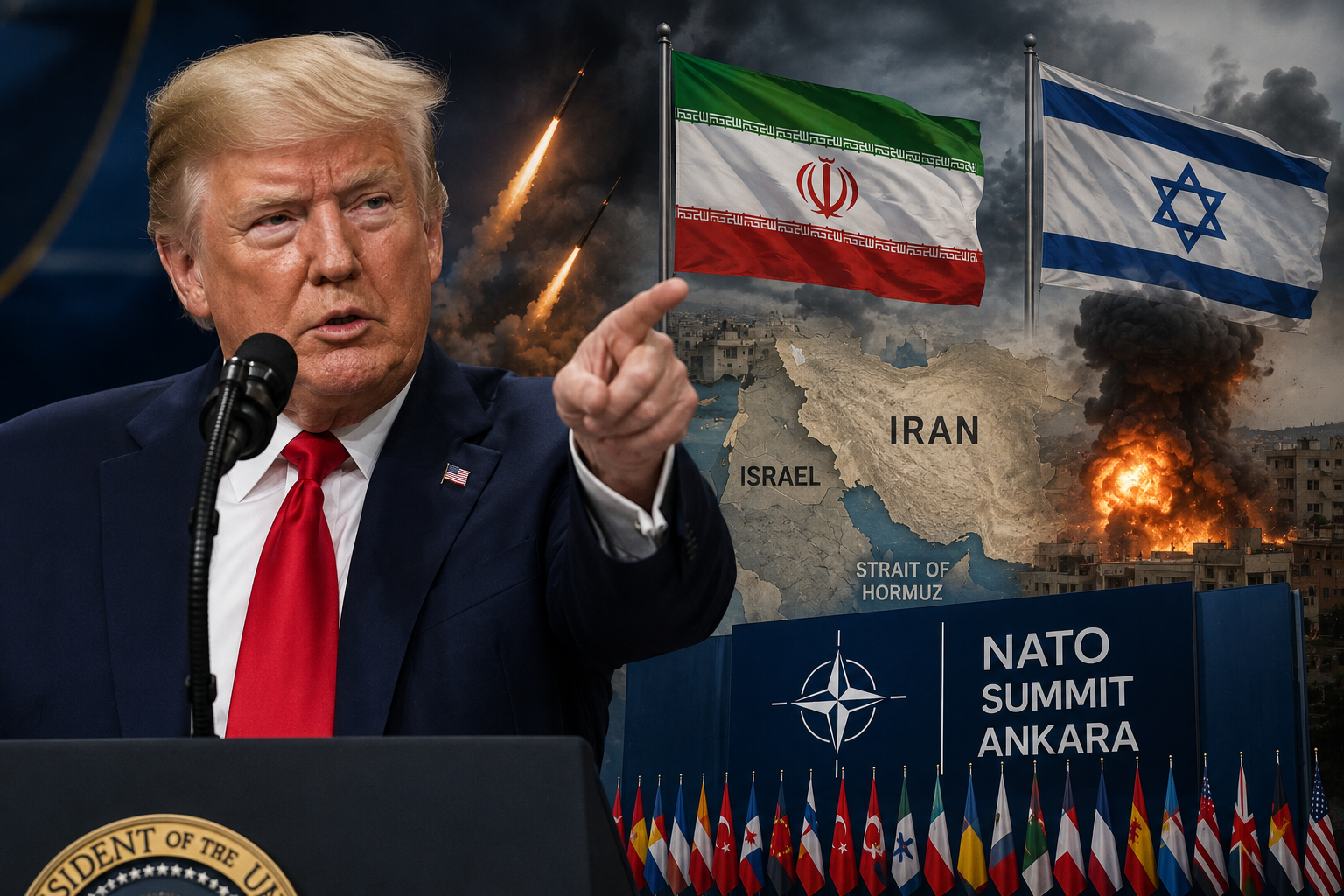

Just hours before NATO leaders gathered in Ankara for a high-stakes summit focused on the alliance’s future security strategy, U.S. President Donald Trump declared that the ceasefire between Iran and Israel was effectively over. His remarks added fresh uncertainty to an already tense geopolitical environment dominated by conflicts in the Middle East and Eastern Europe.
Speaking to reporters before the summit, Trump argued that recent developments had rendered the ceasefire meaningless. His comments came as NATO members prepared to discuss major security challenges, including the ongoing Russia-Ukraine war, instability in the Middle East, maritime security in the Strait of Hormuz, and the future role of the United States within the alliance.
Trump Questions Value of Continued Diplomacy
When asked whether the ceasefire remained in effect, Trump responded that, in his view, “the ceasefire is over.” He criticized Iran’s leadership, claiming it had acted irrationally and suggesting that diplomatic negotiations had lost much of their value.
Trump stated that communication channels with Tehran would remain technically open through intermediaries but indicated he had little confidence that meaningful progress could still be achieved.
He also repeated his long-standing position regarding Iran’s nuclear program, arguing that if Iran possessed a nuclear weapon, it would be willing to use it. The statement reflects Trump’s broader security stance but has not been supported by new publicly released intelligence during the summit.
Source: Statements made by U.S. President Donald Trump during remarks to reporters ahead of the NATO Summit.
Remarks on Regional Leaders
During the same exchange with journalists, Trump drew a distinction between Iran’s leadership and several international leaders with whom he said he maintains positive relationships.
He specifically praised Turkish President Recep Tayyip Erdoğan and Israeli Prime Minister Benjamin Netanyahu, describing both as leaders who are practical and easier to negotiate with than Iran’s current government.
The comments came as diplomatic efforts continued across multiple channels to prevent further escalation following recent military exchanges involving Iran and Israel.
NATO Summit Focuses on a Changing Security Landscape
Although Trump’s remarks dominated headlines before the summit officially opened, NATO leaders were expected to concentrate on broader strategic issues affecting the alliance.
One of the summit’s principal themes is the future distribution of defense responsibilities among member states. The United States has repeatedly urged European allies to increase military spending and assume a greater share of NATO’s collective defense burden.
Alliance leaders are also expected to examine the prolonged Russia-Ukraine conflict, security in the Black Sea region, and recent tensions affecting energy supplies and international shipping routes through the Strait of Hormuz.
These discussions are widely viewed as part of NATO’s evolving long-term security framework, often described by analysts as a new phase in the alliance’s strategic development.
Trump Comments on Greenland and NATO Allies
Trump also addressed Greenland, revisiting his long-standing interest in the strategically important Arctic territory.
He argued that Greenland holds greater importance for the United States than for Denmark and repeated his view that returning control of the territory to Denmark after World War II had been a mistake.
The president additionally criticized some NATO allies over their responses to recent tensions involving Iran. He suggested that several member states had not provided sufficient political support for the United States during the crisis and specifically criticized Spain’s position while also referencing the United Kingdom’s military posture.
These remarks are likely to generate further discussion among alliance members already navigating differing perspectives on defense policy, burden-sharing, and Middle East strategy.
Security Challenges Expected to Dominate Summit Agenda
Despite the controversy surrounding Trump’s comments, NATO officials remain focused on strengthening alliance cohesion at a time of multiple global crises.
The summit in Ankara is expected to produce discussions on collective defense planning, military readiness, cyber threats, and long-term deterrence strategies. Leaders are also seeking consensus on how NATO should respond to evolving challenges across Europe, the Middle East, and the Arctic.
Trump’s declaration regarding the Iran ceasefire is likely to remain one of the summit’s defining political moments, underscoring how rapidly changing events outside Europe continue to shape NATO’s strategic priorities and diplomatic agenda.