



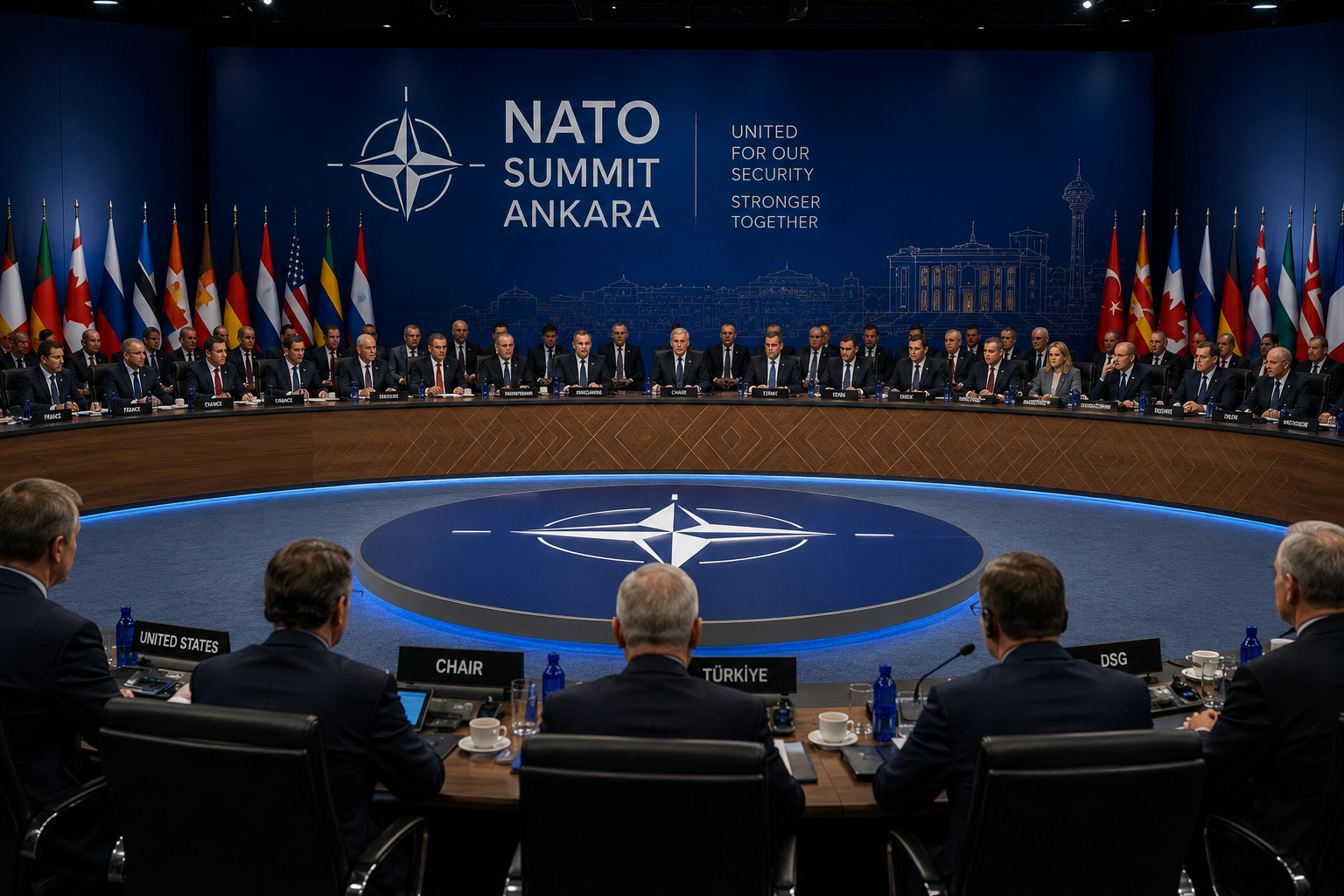

NATO leaders concluded the 36th NATO Summit in Ankara by issuing a joint declaration reaffirming the alliance’s commitment to Article 5 of the Washington Treaty, the cornerstone of NATO’s collective defense doctrine. The communiqué emphasized that an attack against one ally remains an attack against all, underscoring the alliance’s determination to respond collectively to emerging global security challenges.
The declaration highlighted NATO’s continued unity at a time of increasing geopolitical uncertainty. Leaders described the alliance as the foundation of peace, stability, and prosperity for nearly one billion people living across NATO member states.
Beyond reaffirming its traditional defense commitments, the summit focused heavily on military modernization, support for Ukraine, emerging technologies, and instability in the Middle East.
Russia and Terrorism Remain Primary Security Concerns
The Ankara declaration identified Russia as NATO’s principal long-term strategic challenge to Euro-Atlantic security, while also recognizing terrorism as an enduring threat requiring continued multinational cooperation.
Alliance members agreed that maintaining credible deterrence requires sustained investment across every domain of modern warfare.
According to the declaration, European allies and Canada increased core defense spending by more than $139 billion in 2025 compared with previous commitments.
Leaders also announced over $50 billion in new defense procurement initiatives during the Ankara summit. The investments are expected to strengthen NATO’s industrial production capacity while accelerating cooperation with private defense companies developing next-generation military technologies.
The communiqué stressed that future deterrence will increasingly rely on integrated air and missile defense systems, long-range precision strike capabilities, unmanned platforms, cyber defense, space assets, advanced intelligence systems, and artificial intelligence.
“A Stronger Europe Inside a Stronger NATO”
One of the declaration’s central themes was the vision of “a stronger Europe within a stronger NATO.”
Leaders emphasized that European members and Canada are assuming greater responsibility for the alliance’s collective defense while continuing to work closely alongside the United States.
The declaration also outlined plans to improve interoperability through a common transatlantic combat cloud, expanded digital battlefield integration, and wider adoption of AI-supported military systems.
NATO officials argued that these investments are intended to ensure the alliance remains technologically competitive amid rapidly evolving global security challenges.
Long-Term Support for Ukraine Expanded
Support for Ukraine remained another major pillar of the summit.
The declaration reaffirmed NATO’s backing for Ukraine’s sovereignty, independence, and internationally recognized territorial integrity.
Member states announced commitments totaling €70 billion in military assistance, equipment, logistics, and training for 2026. Leaders also confirmed their intention to maintain at least the same level of assistance throughout 2027, describing long-term predictability as essential for Ukraine’s defense planning.
The communiqué noted that much of the assistance would continue to be financed through bilateral agreements and multinational coordination among European allies and Canada.
Iran and the Strait of Hormuz Addressed
The Ankara declaration also focused on growing instability in the Middle East.
Alliance leaders reiterated that Iran must not acquire a nuclear weapon and called on Tehran to fully respect freedom of navigation in the Strait of Hormuz, one of the world’s most strategically important maritime corridors for global energy supplies.
The document further warned that NATO must remain prepared for hybrid threats, strategic competition, cyberattacks, and recurring regional crises that could directly affect allied security.
Turkey Receives Recognition for Hosting the Summit
The declaration concluded by thanking Turkey for hosting the summit and facilitating discussions among alliance leaders during a period of heightened international tension.
Officials praised Ankara’s organizational efforts and expressed their intention to continue working together at future NATO meetings as the alliance adapts to an increasingly complex security environment.
Analysts Debate NATO’s Long-Term Strategic Direction
Although the summit demonstrated strong unity among member states, discussions surrounding NATO’s future continue beyond official policy circles.
Some geopolitical analysts have suggested that the emergence of a more multipolar international system could eventually encourage debates over alternative Eurasian security architectures that reduce Europe’s dependence on the United States and place greater emphasis on continental security arrangements. Supporters of these ideas often point to geography, energy networks, and shifting global power balances as reasons for exploring different long-term models.
However, these perspectives remain outside NATO’s official policy. The alliance’s current Strategic Concept continues to identify Russia as the principal long-term threat to Euro-Atlantic security while reaffirming the United States as NATO’s leading strategic partner and security guarantor.
For now, the Ankara declaration leaves little doubt about the alliance’s immediate priorities: strengthening collective defense, accelerating military modernization, supporting Ukraine, countering emerging threats, and preserving unity among member states despite an increasingly complex geopolitical landscape.