



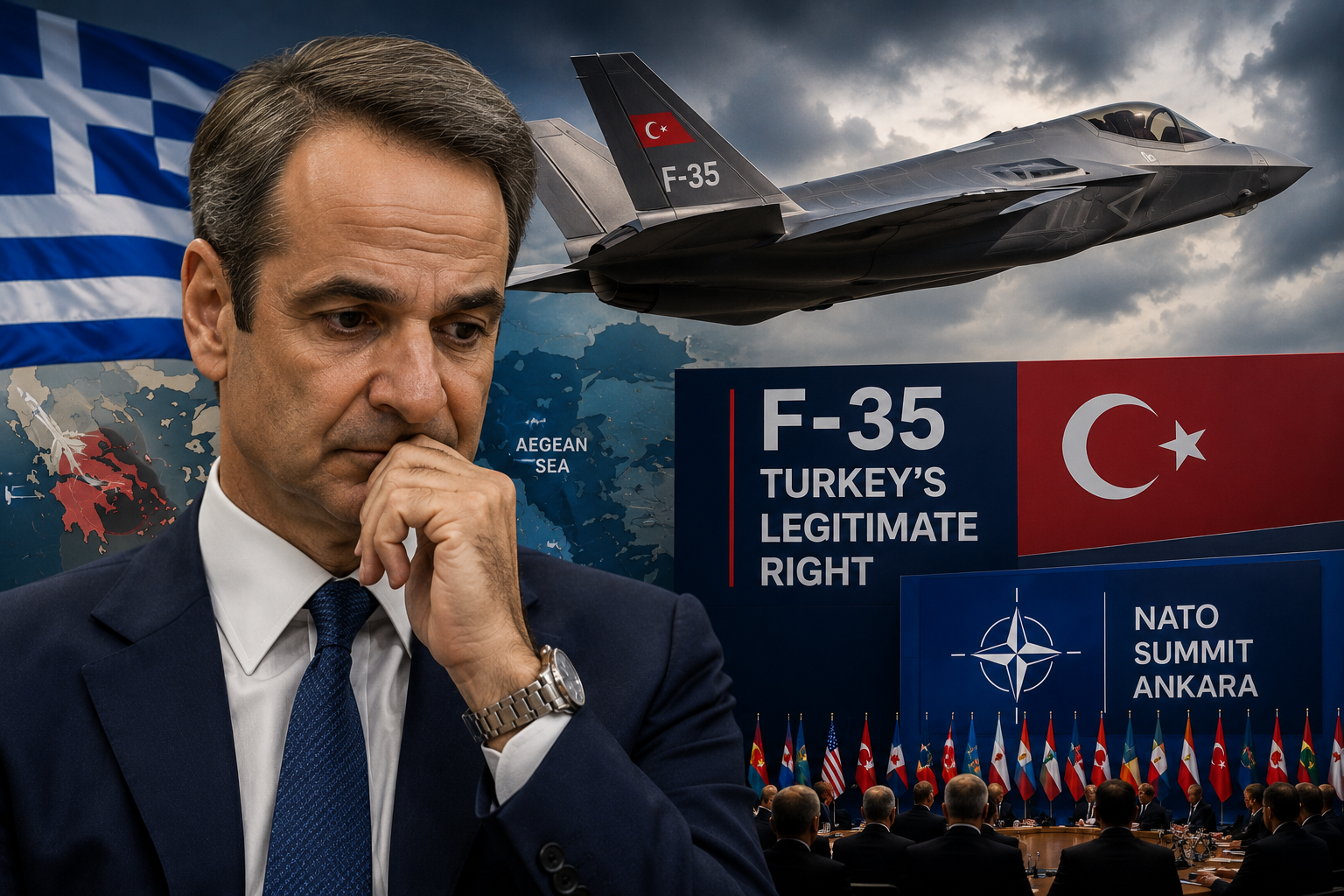

Greek Prime Minister Kyriakos Mitsotakis expressed concern after U.S. President Donald Trump signaled that Washington could reconsider Turkey’s access to the F-35 fighter jet program during the NATO summit in Ankara.
Mitsotakis argued that NATO allies should take Greece’s security concerns seriously, claiming that Athens still faces what he described as an open threat of war from Turkey. His remarks came as alliance leaders met to discuss defense spending, regional security, and NATO’s future strategy.
However, Ankara’s position is clear: Turkey was one of the original F-35 program partners, invested in the project, and maintains that returning to the program is a legitimate defense right. Turkey was removed from the program after purchasing the Russian S-400 air defense system, a decision announced by the United States in 2019.
Ankara Sees F-35 Access as a NATO Right
Turkey is not a minor actor inside NATO. It has long been described as having the alliance’s second-largest military force, giving it a central role in Black Sea security, Middle East stability, and NATO’s southeastern flank.
For Ankara, the F-35 issue is not simply about aircraft. It is about strategic equality inside NATO. Turkish officials and analysts argue that a country carrying such a heavy defense burden should not be permanently excluded from a program it helped build.
Trump’s latest remarks suggested a possible shift in U.S. policy, although legal and congressional barriers remain. Reuters reported that Trump said he would move to lift sanctions on Turkey and consider the F-35 question during talks with President Recep Tayyip Erdoğan.
Greece Revives the “War Threat” Argument
Mitsotakis once again framed the issue through the Aegean dispute, saying an alliance must be based on good-neighborly relations. Greece has repeatedly referred to Turkey’s position on Aegean maritime expansion as a casus belli threat.
The dispute dates back to Greece’s potential extension of territorial waters to 12 nautical miles in the Aegean, a move Turkey has warned would severely affect its access and rights in the region.
Yet Ankara has never launched a war against Greece over this issue. Critics of Mitsotakis argue that the Greek government frequently uses the Turkey threat narrative to consolidate domestic political support, especially during periods of regional tension.
Cyprus History Remains Central to Ankara’s View
The Cyprus issue also remains a major part of Turkey’s security argument. Turkish Cypriots suffered severe violence during the 1963–64 intercommunal conflict, known among Turkish Cypriots as Bloody Christmas. Historical accounts record that tens of thousands of Turkish Cypriots were displaced from more than 100 villages during that period.
Turkey argues that its 1974 Cyprus Peace Operation was launched to protect Turkish Cypriots after years of insecurity and political violence, including actions linked to Greek Cypriot nationalist groups such as EOKA and later EOKA-B Terror.
This history remains deeply relevant for Ankara, especially when Greek and Greek Cypriot officials accuse Turkey of aggression while avoiding deeper discussion of the violence faced by Turkish Cypriots.
Migration, EU Politics, and Double Standards
The dispute also extends into the European Union. Greece and the Greek Cypriot administration have repeatedly opposed Turkey’s path toward full EU membership, while Ankara accuses Brussels of applying double standards.
Greek border practices have faced repeated scrutiny from human rights groups, the United Nations, and European institutions over allegations involving migrant pushbacks, deaths, and abuse. Despite those controversies, critics argue that Athens has faced limited concrete consequences.
For many observers, this gives Mitsotakis a political advantage: Greece can invoke European solidarity against Turkey while continuing to use Turkey as a domestic political tool.
Political Rivalry Overshadows Public Similarities
The irony is that ordinary Turks and Greeks share deep cultural similarities, from food and music to family traditions and daily life. Public hostility is often far weaker than political rhetoric suggests.
The real question is how long regional leaders will continue turning historical disputes into electoral weapons. As Turkey seeks renewed F-35 access and Greece raises objections, NATO faces a familiar dilemma: whether alliance unity will be shaped by strategic necessity or by old political narratives.