



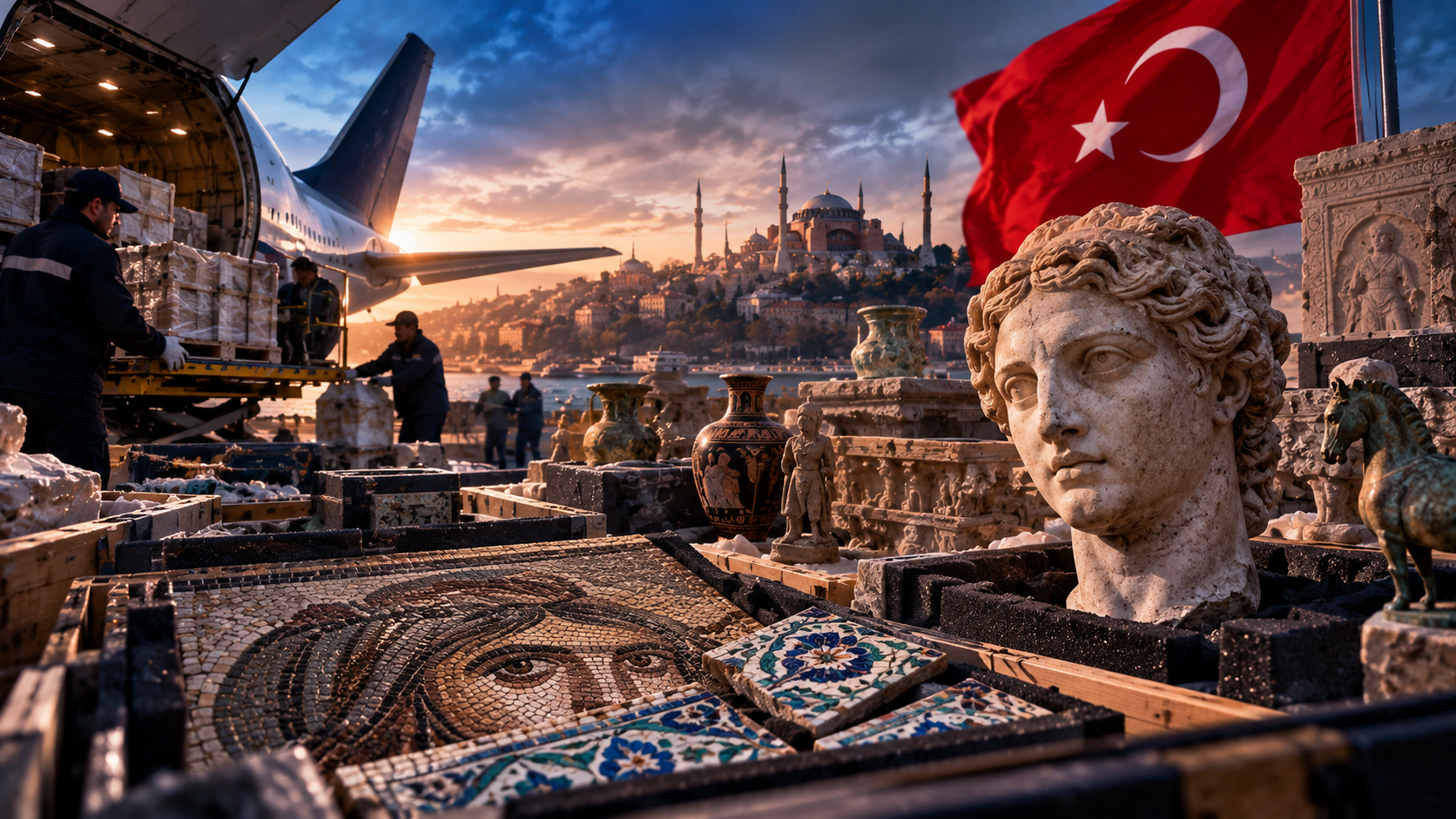

Turkey has recovered 28,811 cultural artifacts taken abroad since 1980, marking a major milestone in a decades-long campaign to trace archaeological and historical objects removed from the country and return them to their places of origin.
Teams working under Turkey’s Ministry of Culture and Tourism have pursued objects across museums, collections and international markets through a combination of provenance research, diplomatic negotiations, legal proceedings and voluntary returns.
According to data attributed to the ministry’s General Directorate of Cultural Heritage and Museums, Turkish authorities have carried out 176 repatriation efforts across 20 countries during the 46-year period from 1980 through 2026.
The ministry’s official repatriation inventory documents cases stretching from major archaeological collections returned during the 1980s and 1990s to individual sculptures, mosaics and architectural pieces recovered in recent years.
Germany Leads Artifact Returns to Turkey
The largest number of recovered objects came from Germany, according to the latest figures.
A total of 8,670 cultural objects were returned from Germany, followed by 4,147 from Croatia and 3,750 from the United Kingdom.
Turkey also recovered 3,061 objects from Bulgaria, 2,747 from the United States and 1,865 from Serbia. Together, those countries account for a substantial share of the cultural property returned during the decades-long campaign.
The figures do not represent a single operation. They are the cumulative result of numerous independent cases spanning decades and involving objects ranging from ancient coins and archaeological fragments to sculptures and decorative elements removed from historic buildings.
Turkey’s official repatriation list illustrates the scale and diversity of the effort. Earlier cases include objects associated with Aphrodisias, the Lydian Treasure, Elmalı coins, Boğazköy and Boubon, alongside religious and architectural artifacts taken from historic sites.
Smyrna Sculpture Returns From United States
The repatriation campaign continued in 2026, with several significant objects returning to Turkey.
Among them was a fifth-century marble sculpture head from ancient Smyrna, which was returned from the United States after provenance research connected it to excavations at the Smyrna Agora in modern-day Izmir.
Archival and scientific documentation dating to 1934 helped establish that the sculpture had been excavated at Smyrna before eventually leaving Turkey. The object had been held by the Denver Art Museum, and its return followed discussions between Turkish authorities and the museum.
The marble head is associated with the Theodosian period of the fifth century A.D. and has been identified as a work connected to the artistic tradition of the Ephesus-Smyrna region. It is now displayed at the Izmir Archaeology Museum.
Turkey’s official repatriation inventory records the marble sculpture head among the cultural objects returned from the United States in 2026.
Historic Iznik Tiles Come Home
The year’s recoveries were not limited to archaeological objects from antiquity.
Turkey also secured the return of historic Iznik tiles, examples of one of the most internationally recognized traditions of Ottoman ceramic art.
Two tiles were returned from Spain, while additional Iznik tiles were recovered from the United Kingdom, according to the General Directorate’s official inventory.
Reporting based on ministry data linked the Spanish returns to tiles stolen from Adana Ulu Mosque in 2002 and 2003. The historic mosque is particularly known for its 16th- and 17th-century tiles decorating its qibla wall.
The 2026 recoveries also included Iznik tiles connected to historic mosques in Istanbul, demonstrating that cultural-property trafficking affects not only archaeological sites but also surviving monuments and religious buildings.
Zeugma Mosaic Recovered From United States
Another notable 2026 case involved a mosaic panel originating from the ancient city of Zeugma, one of Turkey’s most important archaeological sites.
The panel was returned from the United States, according to the ministry’s official repatriation records.
Zeugma, located in southeastern Turkey, is internationally renowned for its Roman-era mosaics. Objects connected to such archaeological sites can become particularly difficult to recover once they enter private collections or move through the international antiquities market, making documentation of their provenance crucial to repatriation efforts.
The official inventory records the Zeugma panel as a separate 2026 return alongside the Smyrna sculpture and Iznik tiles.
A 46-Year Campaign Against Cultural Trafficking
Turkey’s recovery effort reflects a broader international shift toward examining the provenance of archaeological objects and cultural property held outside their countries of origin.
For Turkish authorities, establishing where an artifact came from can involve archaeological excavation records, museum inventories, photographs, archival documents and other evidence demonstrating that an object originated in Turkey and subsequently left the country.
The Smyrna case demonstrates how important those records can become decades later. Documentation dating back more than 90 years played a role in establishing the history of the marble sculpture and ultimately facilitating its return.
The government’s official database shows that the campaign has grown from early returns involving individual artifacts to cases encompassing hundreds or even thousands of objects. In 2024 alone, for example, 1,055 coins were returned from Greece, while earlier repatriations included thousands of objects from Croatia and thousands of Boğazköy tablets from Germany.
With 28,811 cultural objects now reported as recovered since 1980, Turkey’s campaign represents nearly half a century of efforts to reverse the international movement of cultural property removed from Anatolia.
The continuing returns of objects from Smyrna, Zeugma and historic Ottoman monuments also demonstrate that the process remains active. For Turkish cultural authorities, each successful repatriation is not simply the recovery of an individual object, but the restoration of a piece of archaeological, artistic or architectural heritage to the historical setting from which it originated.