



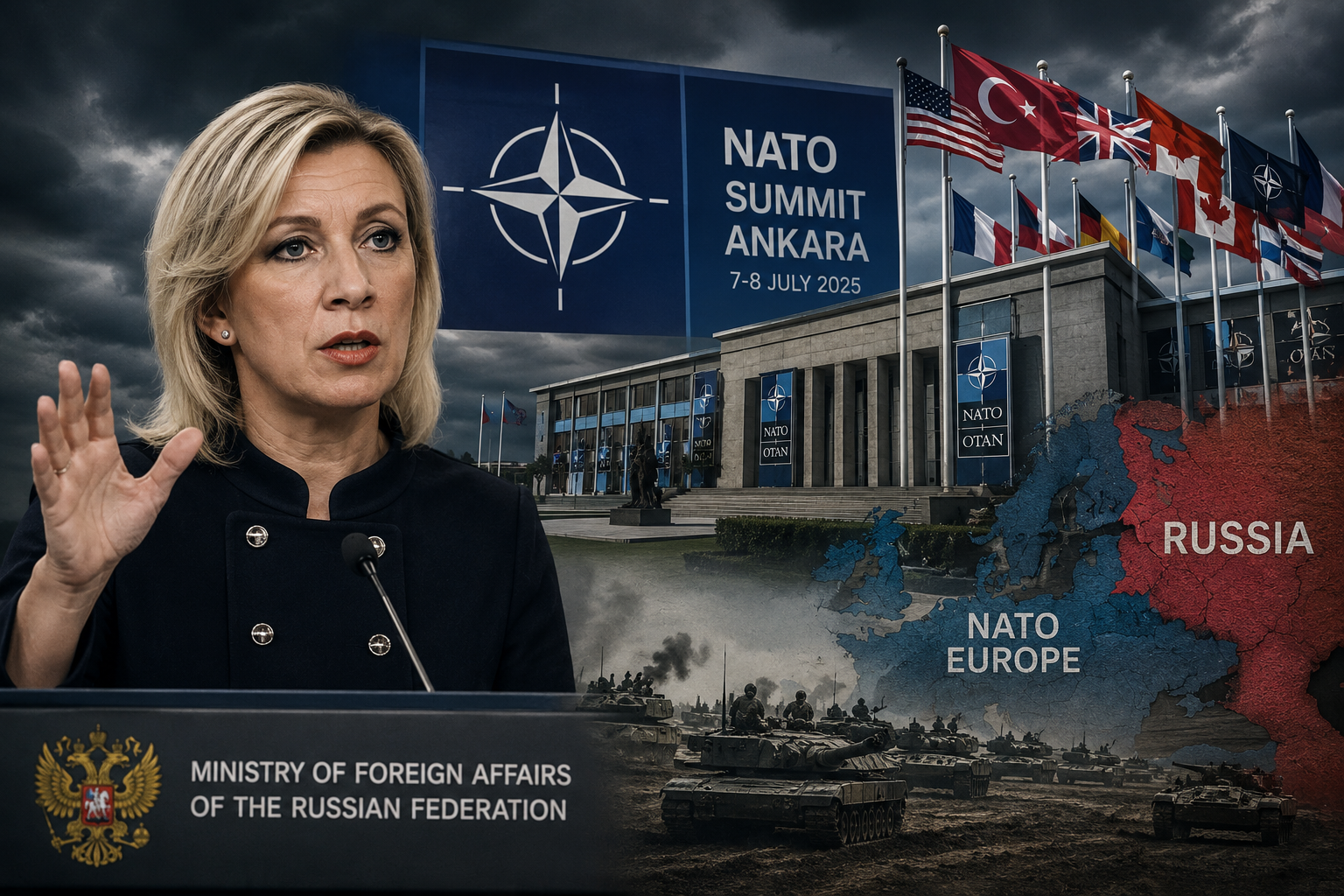

Russia has sharply criticized the outcome of the 36th NATO Summit in Ankara, accusing the military alliance of expanding Europe’s militarization and preparing for a potential armed confrontation with Moscow.
In a written statement released after the summit, Russian Foreign Ministry spokeswoman Maria Zakharova argued that NATO’s latest strategic decisions demonstrate that the alliance remains focused on strengthening its military capabilities rather than pursuing diplomatic engagement.
Her comments came shortly after NATO leaders reaffirmed Article 5 of the Washington Treaty, announced major increases in defense investments, and pledged continued military assistance for Ukraine over the coming years.
Moscow Claims NATO Is Preparing for Conflict
Zakharova argued that NATO continues to portray Russia as its principal long-term security threat despite, according to Moscow, the absence of evidence that Russia is preparing to attack NATO member states.
She claimed the Ankara declaration confirms that every allied government endorsed a strategy centered on deterring Russia and expanding military preparedness across Europe.
According to Zakharova, the alliance’s long-term defense planning demonstrates what she described as a growing emphasis on confrontation rather than dialogue.
“NATO continues concentrating on militarizing the European continent, increasing its defense potential, preparing for armed confrontation with Russia, and expanding military assistance to Ukraine,” Zakharova said in the statement.
Source: Statement released by the Russian Foreign Ministry.
Russia Says NATO Members Remain Divided
Zakharova also questioned NATO’s internal cohesion despite the alliance presenting a united front during the Ankara summit.
She argued that disagreements among member states remain unresolved and suggested that European governments continue working to maintain strong American military engagement on the continent.
According to the Russian Foreign Ministry, several NATO governments remain concerned about the possibility of the United States reducing its long-term military presence in Europe.
Zakharova claimed that recent declarations of solidarity made by European leaders and Canada do not eliminate deeper political differences inside the alliance.
Defense Spending Draws Criticism From Moscow
Another major focus of Russia’s criticism involved NATO’s expanding military expenditures.
The Ankara declaration announced that European allies and Canada increased defense investments by more than $139 billion in 2025 while unveiling over $50 billion in additional defense procurement projects during the summit.
Zakharova questioned whether such financial resources could instead be directed toward addressing social and economic challenges facing European societies.
She also criticized NATO’s long-term military modernization plans involving missile defense, cyber capabilities, artificial intelligence, advanced surveillance technologies, and unmanned systems.
Ukraine Remains at the Center of Dispute
The Kremlin also objected to NATO’s continued support for Ukraine.
The Ankara declaration confirmed allied commitments totaling €70 billion in military assistance, equipment, logistics, and training for Ukraine during 2026, while leaders also pledged to maintain comparable support throughout 2027.
Zakharova claimed that several Western governments continue using Ukraine as part of a broader geopolitical strategy aimed at weakening Russia.
She further argued that increasing military aid comes at the expense of domestic priorities across Europe, suggesting that governments are allocating greater resources to defense while reducing investment in social programs.
Those claims reflect the Russian government’s position. NATO and its member states maintain that military assistance to Ukraine is intended to help the country defend its sovereignty and internationally recognized borders following Russia’s full-scale invasion in 2022.
Greenland and NATO Burden-Sharing Also Mentioned
Zakharova additionally argued that Washington remains dissatisfied with aspects of NATO’s internal burden-sharing despite public declarations of alliance unity.
She referred to recent discussions involving Greenland and suggested that the United States has not always received the level of political support it expected from European allies during periods of strategic tension.
The Russian Foreign Ministry also estimated that NATO members’ combined defense spending could approach $1.8 trillion in 2026, presenting that figure as evidence of the alliance’s accelerating military expansion.
Competing Security Narratives Continue
The exchange highlights the widening divide between NATO and Russia over European security.
NATO leaders insist that increased military investment is a defensive response to Russia’s actions in Ukraine and broader security concerns across the Euro-Atlantic region. Alliance officials argue that deterrence, collective defense, and technological modernization are essential for preserving stability.
Moscow, meanwhile, continues to portray NATO’s expansion and military buildup as evidence that the alliance is pursuing confrontation instead of diplomacy.
As tensions remain high following the Ankara Summit, competing narratives from Brussels and Moscow illustrate how differently both sides interpret the same security developments, making meaningful dialogue increasingly difficult while reinforcing the broader geopolitical rivalry shaping Europe’s future security environment.