



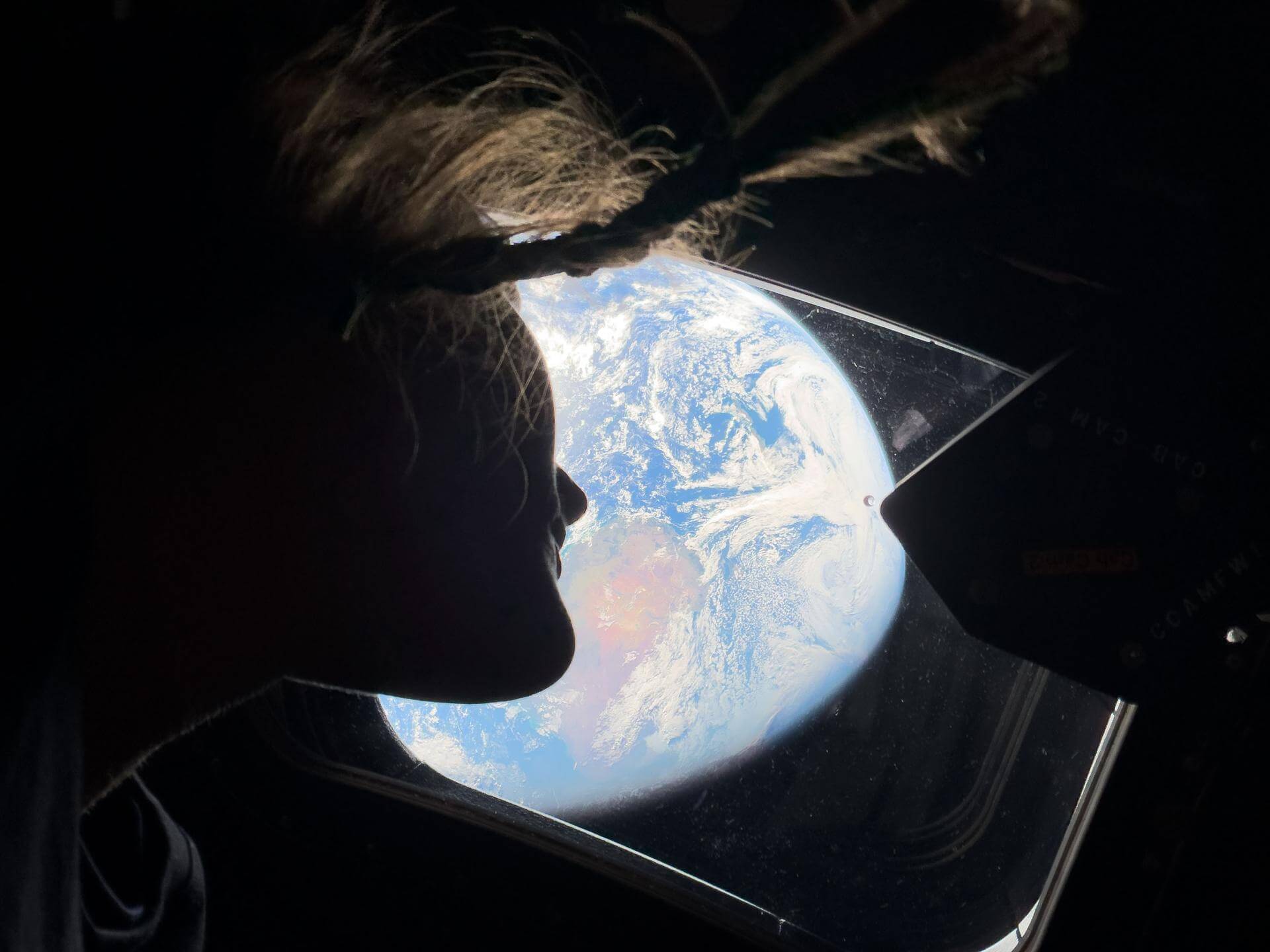

The Artemis II mission, led by NASA, has delivered a landmark moment in modern space exploration as astronauts aboard the Orion spacecraft reported their first-ever direct view of the Moon’s far side. The crew—Reid Wiseman, Victor Glover, Christina Koch, and Canadian Space Agency astronaut Jeremy Hansen—entered the third day of their mission with a profound sense of discovery.
Describing the experience as “absolutely spectacular,” the astronauts emphasized how different the far side of the Moon appears compared to the familiar Earth-facing surface. “Something about you senses that this is not the Moon that I’m used to seeing,” said Christina Koch, highlighting the emotional and visual impact of the moment.
Unseen Lunar Terrain Revealed
First Human View of Orientale Basin
One of the mission’s most remarkable achievements was capturing a clear image of the Orientale Basin, a massive impact crater located on the Moon’s far side. According to NASA, this marks “the first time the entire basin has been seen with human eyes.”
The Orientale Basin, formed billions of years ago by a colossal asteroid impact, is considered one of the most well-preserved multi-ring basins in the solar system. While robotic missions have previously photographed it, the Artemis II crew’s direct observation represents a significant milestone in human spaceflight and lunar exploration.
Distance and Mission Progress
As of late Saturday, NASA’s official tracking systems indicated that the Artemis II spacecraft had traveled more than 180,000 miles (289,681 kilometers) from Earth. This distance places the crew deep into cislunar space, a region that has remained largely unexplored by human missions since the Apollo era.
The Artemis II mission is designed as a crewed test flight, validating systems that will be crucial for future lunar landings under NASA’s broader Artemis program. Unlike the Apollo missions, Artemis aims to establish a sustainable human presence on the Moon and pave the way for missions to Mars.
A New Chapter in Space Exploration
The crew’s observations underscore the transformative potential of the Artemis program. By revisiting the Moon with advanced technology and international collaboration, agencies like NASA and the Canadian Space Agency are redefining humanity’s relationship with space.
Experts note that firsthand human observation provides a unique perspective that robotic missions cannot fully replicate. The ability to interpret terrain, lighting, and geological features in real time enhances scientific understanding and mission planning.
As the Artemis II crew continues their journey, their experiences are expected to inspire a new generation of explorers while contributing valuable data for upcoming missions, including Artemis III, which aims to return humans to the lunar surface.
Looking Ahead
The successful progression of Artemis II signals a critical step toward long-term lunar exploration. With each milestone, the mission reinforces the importance of international cooperation, technological innovation, and human resilience in expanding the boundaries of space exploration.
As humanity once again reaches beyond Earth’s orbit, the far side of the Moon—once hidden and mysterious—is now becoming a gateway to the future of deep space discovery.