





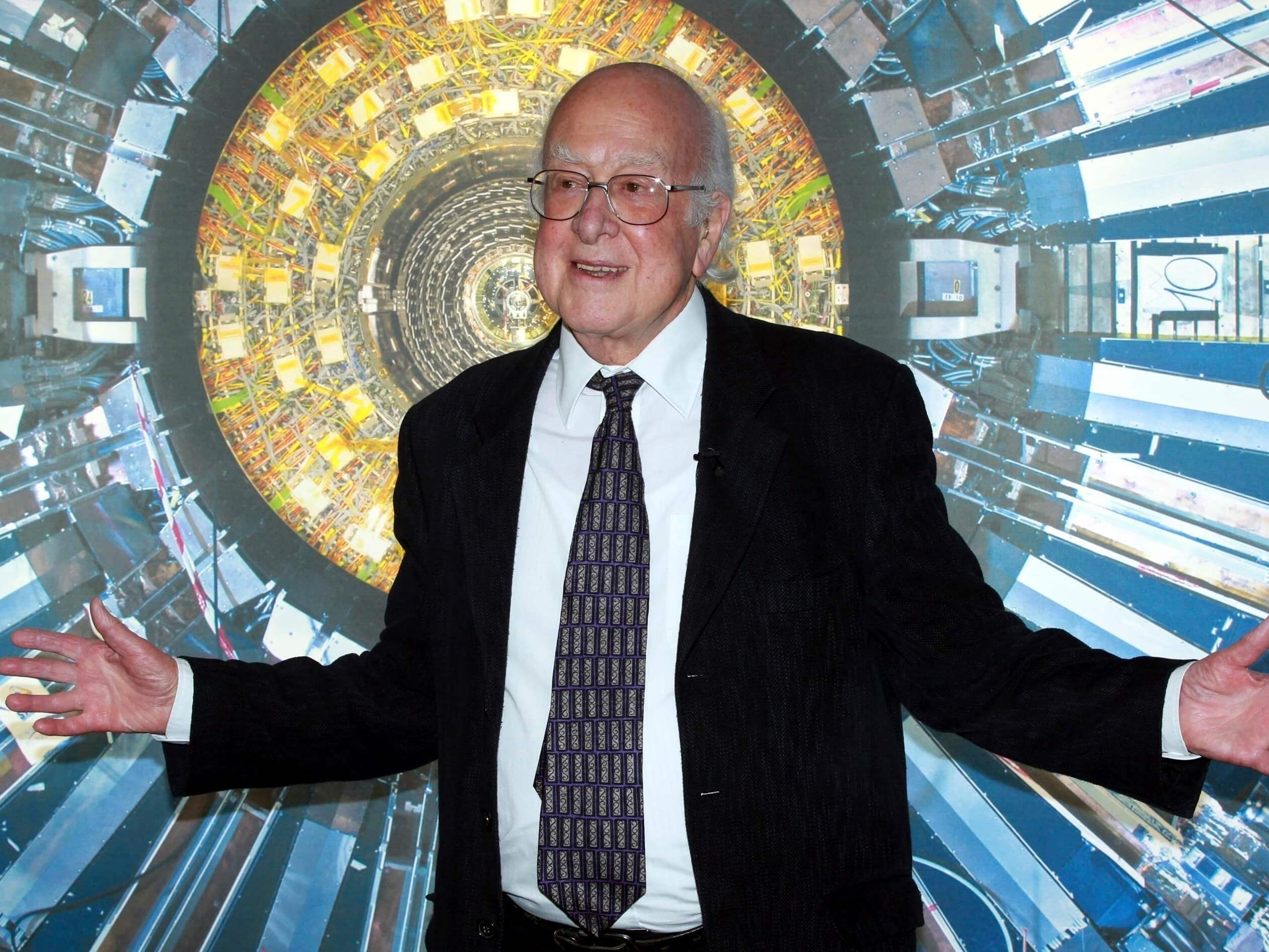

Peter Higgs, the British theoretical physicist whose work led to the discovery of the Higgs boson, has died, marking the end of a remarkable chapter in modern physics. Higgs’ groundbreaking theories fundamentally reshaped our understanding of how particles acquire mass, making him one of the most influential scientists of the 20th and 21st centuries.
His contributions not only transformed particle physics but also played a central role in advancing humanity’s understanding of the fundamental structure of the universe.
The Theory That Changed Physics
In 1964, Higgs proposed a revolutionary idea to explain why certain elementary particles have mass while others do not. This concept introduced what is now known as the Higgs field, an invisible energy field that permeates the universe.
Understanding the Higgs Boson
m=gv/2
This theoretical framework implied the existence of a corresponding particle—the Higgs boson—often referred to as the “God particle” in popular media. For decades, the particle remained purely hypothetical, eluding experimental confirmation.
That changed in 2012, when scientists at CERN’s Large Hadron Collider (LHC) confirmed the existence of the Higgs boson. According to official announcements by CERN, the discovery provided decisive validation of Higgs’ theory and completed a missing piece of the Standard Model of particle physics.
Nobel Prize and Global Recognition
Following the discovery, Peter Higgs was awarded the Nobel Prize in Physics in 2013, alongside Belgian physicist François Englert, who independently developed similar theoretical work.
A Quiet Revolutionary
Despite the global significance of his contributions, Higgs was known for his modest personality and preference for a quiet academic life. He spent much of his career at the University of Edinburgh, where he developed his groundbreaking ideas.
Colleagues and institutions worldwide have credited Higgs with providing one of the most important theoretical foundations in modern science, influencing decades of experimental research.
A Legacy in Modern Science
Higgs’ work extended beyond a single discovery. His theoretical insights helped guide the design and purpose of massive scientific instruments like the Large Hadron Collider, one of the most complex machines ever built.
Impact on Future Research
The confirmation of the Higgs boson has opened new avenues in physics, including research into dark matter, quantum fields, and the early conditions of the universe. Scientists continue to build upon Higgs’ work to explore unanswered questions about reality itself.
Enduring Influence
The death of Peter Higgs represents a profound loss for the global scientific community. Yet his legacy endures through the theories, experiments, and discoveries that continue to shape our understanding of the universe.
His name will remain permanently embedded in scientific history, not only through the Higgs boson but also through the deeper insight he provided into the fundamental laws governing existence.
As physics moves forward into new frontiers, the influence of Higgs’ work will remain a guiding force—proof that a single idea can redefine how humanity sees the universe.